
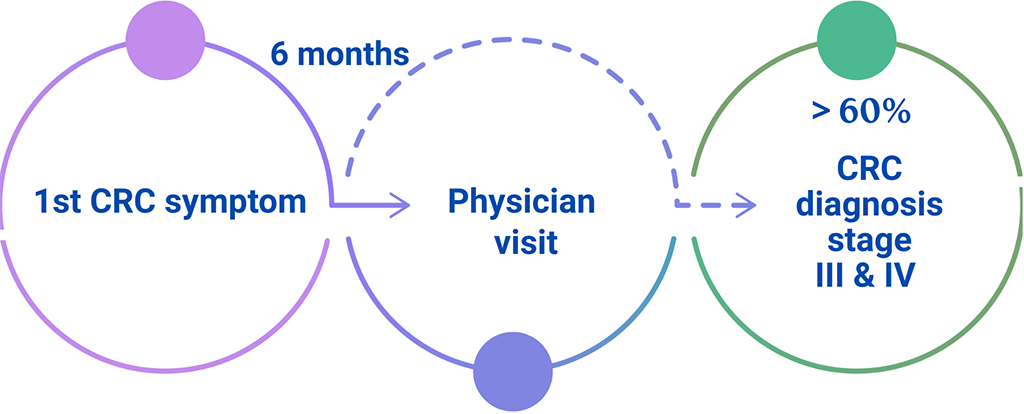
Usually, a patient with colorectal cancer will visit their gastroenterologist for a colonoscopy six months to one year after the initial onset of symptoms. This detail results in the majority of cases (>60%) being diagnosed at a fairly advanced stage (Stages III or IV), where the disease is difficult to manage and chemotherapy is often required.
In areas with a high incidence of CRC, systematic screening has significantly helped to:

  • Reduce the incidence of the disease through early detection and removal of precancerous lesions, such as adenomatous polyps.
  • Reduce mortality, as cancer is diagnosed at an early stage, when treatment is most effective.
  • Improve cost-effectiveness, because early diagnosis reduces the need for expensive treatments in advanced stages.

The prevention of colorectal cancer is therefore crucial, as it allows for the early detection of the disease in its initial stages, significantly increasing the chances of cure.

  1. Morgan E, Arnold M, Sexton R, Giacometti S, Laversanne M, Bray F. Global burden of colorectal cancer in 2020 and 2040: incidence and mortality estimates from GLOBOCAN. Gut. 2023;72(2):338 44.
  2. Sung H, Ferlay J, Siegel RL, Laversanne M, Soerjomataram I, Jemal A, et al. Global cancer statistics 2020: GLOBOCAN estimates of incidence and mortality worldwide for 36 cancers in 185 countries. CA Cancer J Clin. 2021;71(3):209 49.
  3. Alzahrani SM, Al Doghaither HA, Al-Ghafari AB. General insight into cancer: An overview of colorectal cancer. Mol Clin Oncol. 2021;15(6):271.
  4. Zhang J, Zhang Y, Liu C, Li J, Chen Y, Wang X, et al. Global burden and cross-country health inequalities of early-onset colorectal cancer and its risk factors from 1990 to 2021 and its projection until 2036. BMC Public Health. 2024;24(1):3124.
  5. Tepus M, Yau TO. Non-invasive colorectal cancer screening: an overview. Gastrointest Tumors. 2020;7(3):62 73.
  6. Yarden, Ronit I., et al. “Young onset colorectal cancer patients are diagnosed with advanced disease after multiple misdiagnoses.” Cancer Research 79.13_Supplement (2019): 3347-3347.
  7. SEER Program. Cancer Stat Facts: Colorectal Cancer. National Cancer Institute. Available from: https://seer.cancer.gov/statfacts/html/colorect.html
  8. SEER Program. Cancer Stat Facts: Female Breast Cancer. National Cancer Institute. Bethesda (MD): SEER Program; [cited 2025 Nov 26]. Available from: https://seer.cancer.gov/statfacts/html/breast.html
  9. OECD/European Commission. EU Country Cancer Profile: Greece 2025. OECD Publishing; 2025. Available from: https://doi.org/10.1787/22087cfa-en
  10. Meester RG, Doubeni CA, Zauber AG, Goede SL, Levin TR, Corley DA, et al. Public health impact of achieving 80% colorectal cancer screening rates in the United States by 2018. Cancer. 2015;121(13):2281 5.
  11. Meester RG, Doubeni CA, Zauber AG, Goede SL, Levin TR, Corley DA, et al. Colorectal cancer deaths attributable to nonuse of screening in the United States. Ann Epidemiol. 2015;25(3):208 13.
  12. Sawicki T, Latos M, Sładek M, Gąsiorowska A, Ławnicka H, Słomka A, et al. A review of colorectal cancer in terms of epidemiology, risk factors, development, symptoms and diagnosis. Cancers (Basel). 2021 May 6;13(9):2025.
  13. Durko L, Malecka-Panas E. Lifestyle modifications and colorectal cancer. Curr Colorectal Cancer Rep. 2014;10(1):45 54.
  14. National Comprehensive Cancer Network. NCCN Clinical Practice Guidelines in Oncology: Colorectal Cancer. Version 2.2025. Fort Washington, PA: National Comprehensive Cancer Network; 2025 Jun 24. Available from: https://www.nccn.org/guidelines/guidelines-detail?category=1&id=1437